Brakes Speak a Language
Brake noises are not one problem with volume settings; they are a vocabulary, and each word names its own component, urgency, and price. The difference between a driver who knows the vocabulary and one who does not is routinely $500: the squeal caught this month is a pad job, while the same squeal ignored until it becomes a grind has recruited the rotors, and sometimes the calipers, into the invoice. This guide translates each sound — what makes it, what it usually means, what it occasionally means, and which calendar it puts you on. One ground rule first: brakes are the system where uncertainty resolves toward inspection, because most shops check them free or for a nominal fee credited to any repair, making the price of certainty approximately zero.
The High-Pitched Squeal
The classic high squeal on light braking is, most of the time, engineering working as designed: a small steel tab — the wear indicator — is bolted to the pad specifically to sing against the rotor when friction material wears down to its last few millimeters. It is the cheapest sound in this article, because it means pads-only territory: $150 to $350 per axle, rotors typically surviving. The occasional other causes: glazed pads from overheating (a hard mountain descent will do it), cheap pad compounds that squeal from day one, and morning surface rust that clears within a few stops — that last one is harmless and universal. The distinguishing test is persistence: rust-squeal vanishes after the first minutes; the wear indicator sings every time, and slightly louder each week. When the song becomes constant, you have entered the two-to-four-week window where the repair is still at its minimum price.
The Grind
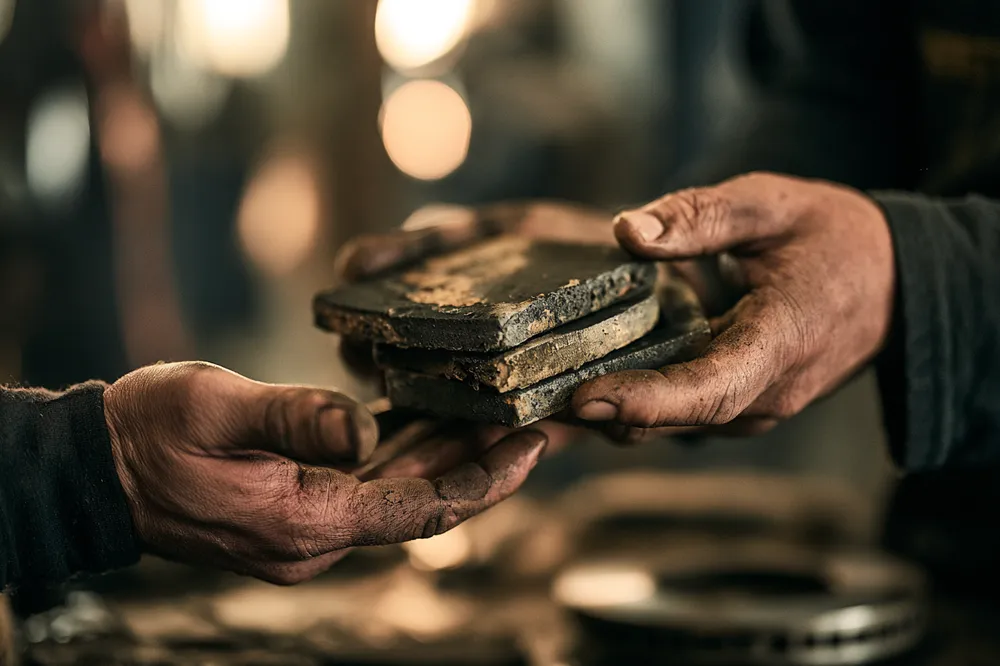
Grinding — a rough metal-on-metal growl felt through the pedal as much as heard — means the friction material is gone and the pad's steel backing plate is machining your rotor with every stop. This is the sound of the invoice growing in real time: rotors that might have been reused are being gouged past their minimum thickness, heat is climbing toward the caliper seals, and stopping distances are already lengthening because steel-on-iron generates a fraction of proper friction. Grinding upgrades the timeline from weeks to days, and the honest advice is to drive gently and directly to an inspection. Expect pads and rotors together — $300 to $650 per axle — and consider it money the earlier squeal was offering to save. One impostor deserves mention: a single stone lodged between rotor and dust shield grinds convincingly but intermittently and typically ejects itself; grinding that is constant and worsens under braking pressure is the real thing.
Thump, Pulse, and Shudder
A rhythmic thump or a pedal that pulses underfoot — often with steering-wheel shudder at highway braking — points at rotors with uneven thickness or hard spots, commonly called warp. The rhythm is the tell: the disturbance repeats with wheel rotation and intensifies with braking force. Causes include heat cycling (riding brakes down long grades), pad material transferred unevenly onto the rotor face, and occasionally lug nuts torqued unevenly at the last tire rotation. The fix is rotor resurfacing where enough thickness remains, or replacement where it does not — and since fresh pads should always meet a true rotor surface, this usually becomes the full pads-and-rotors service. A pulse that appears within weeks of a brake job is a warranty conversation, not a new bill; document it and go back. Persistent shudder also deserves a suspension glance, since worn control-arm bushings amplify brake vibration — the overlap our suspension signs guide maps from the other side.
Scrapes, Clicks, and Rattles
The minor vocabulary matters because it separates cheap fixes from false alarms. A constant light scrape that does not change with braking is often a bent dust shield touching the rotor — a two-minute bend-back, frequently free. A click at the first brake application after reversing is usually pads shifting in their brackets; persistent clicking can mean missing anti-rattle hardware, a $20 kit. A rattle over bumps that silences when you touch the brakes points at worn pad hardware or caliper slide pins — the pins deserve respect, because seized slides cause uneven pad wear and the one-side-pulling behavior that mimics bigger problems. None of these are emergencies; all of them are worth mentioning at the next service, and each is a line-item education in how much brake noise is hardware, not friction material.
The Dangerous Silence
Two brake problems make no noise at all, which is why sound is not the whole diagnostic. A pedal that has grown soft, travels farther, or sinks slowly at a stoplight describes hydraulic trouble — air or moisture in the fluid, or a master cylinder beginning to bypass — and it outranks every noise in this article for urgency. And a car that pulls to one side under braking names a sticking caliper or collapsed hose on the quiet side. Both are same-week inspections; the pedal symptom is same-day. This is also the standing argument for the fluid flush interval — every two to three years — that drivers love to decline: brake fluid absorbs moisture, moisture drops its boiling point and corrodes from within, and the failure mode arrives silently. The economics of that $100–$150 line, and why it should stay on financed brake jobs, are covered in the fluid section of our brake and suspension loans page.
What Each Sound Costs
| Sound | Usual Meaning | Typical Cost (per axle) | Calendar |
|---|---|---|---|
| High squeal, light braking | Wear indicators — pads low | $150 – $350 | 2–4 weeks |
| Morning squeal that fades | Surface rust | $0 | None |
| Constant grind | Pads gone, rotors cutting | $300 – $650 | Days |
| Thump / pedal pulse | Rotor thickness variation | $300 – $650 | 1–2 weeks |
| Click / rattle | Hardware, slide pins | $20 – $150 | Next service |
| Soft or sinking pedal | Hydraulic fault | $100 – $500+ | Today |
| Pull under braking | Sticking caliper | $250 – $500 | Same week |
Acting at the Cheap Moment
Every row of that table tells the same story at different volumes: brake costs are set by response time more than by the car. The playbook is short. Get the free inspection the week a new sound appears, and ask to see the pad measurements and rotor faces — honest shops show you. Fix at the squeal stage when the menu still says pads-only. Never buy silence with cheap pads; economy compounds fade under heat and re-squeal within months. And when the bill lands at the pads-and-rotors-both-axles tier — $500 to $1,100 — on a week the budget did not plan for it, a small fixed-payment personal loan is the tool built for exactly this shape of problem: our brake and suspension loans page covers the financing mechanics, and the calculator converts any estimate into the monthly figure. Stopping distance is the one line item on a car that should never wait for the next paycheck, and it is the rare repair where the safety argument and the financial argument point the same direction with no daylight between them.
The Money Layer: Funding Each Row of the Table
The cost table above quietly doubles as a funding map, because each sound's price band points at its own sensible payment route. The free-and-trivial rows — rust squeal, dust shields, hardware kits — need nothing but a next-service mention. The pads-only row at $150–$350 is the repair fund's bread and butter, and catching the wear indicator at this stage is precisely what makes fund-first households rarely need to borrow for brakes at all. The pads-and-rotors rows at $300–$1,100 are where financing enters honestly for many budgets: safety-critical timing, a days-not-months deadline once grinding starts, and amounts that meet most emergency funds' ceilings — the three conditions under which a fixed-rate personal loan beats both waiting and revolving the bill at card rates. The hydraulic rows are the same logic with the urgency dial turned up.
Two brake-specific financing notes earn their space. First, never let the payment method pick the parts: economy pads chosen to shrink a cash bill re-squeal within months and fade under heat, while the $60 pad upgrade on a financed job amortizes to pocket change monthly — personal loans exist partly so safety components get bought at the right grade. Second, brake bills reward the both-axles-one-visit structure when measurements justify it, and one road loan at the combined figure prices better than two serial small loans, since the road lending market's fee floors punish tiny amounts hardest. The sequence stays the same as everywhere on this site: written estimate with pad measurements, a road loan application sized to it, the monthly figure confirmed in the calculator, and road loans doing what they are for — making the cheap moment reachable on the week it actually arrives.
Bottom Line
Brake sounds are a priced vocabulary, and fluency pays in one specific way: acting at the squeal, when the menu still reads pads-only and personal loans are smallest or unnecessary. Grinding is the sound of that discount expiring daily. Inspections are free, measurements beat adjectives, and quality pads on a financed job cost pocket change monthly while economy pads cost the repair twice. When the both-axles bill lands on an unprepared week, road loans fit the shape exactly — safety timing, defined totals, fixed schedules — and a personal loan funded next-day means the grinding stops before the weekend. Stopping distance never negotiates, which is why this is the one category where borrowing on road loans terms and doing nothing are not two options but a safety decision wearing two costumes.
Reader question worth appending: do these sounds mean the same thing on trucks and SUVs? The vocabulary is identical; only the prices scale. Heavier vehicles wear pads faster under load, run bigger rotors, and quote 20–40% above the sedan figures in the table — which pushes more truck brake jobs into the band where a personal loan enters the conversation. The sound-to-urgency mapping transfers exactly, the squeal-stage discount still applies, and road loans price the heavier invoice the same way: against your file, not your curb weight. A personal loan does not know what you drive; the estimate does. A personal loan also does not scale with axle count — a $900 truck brake job and a $900 sedan job are the identical personal loan — which is one more reason the written number always precedes any personal loan signature.
Keep Reading
8 Signs Your Suspension Is Failing
The symptoms that show up before the clunk, and what each costs.
Brake & Suspension Loans
Financing pads, rotors, struts and alignment from $500 to $5,000.